The manifesto
Visionary Expressionism
The principle of Hermes commends the use of the symbol: we have a source, but one that is ciphered, cryptic, enigmatic.
One of art's principal aims, in my vision, beyond answering the artist's own subjective needs, is to stir and rekindle the collective sentience; in the symbolic transfiguration of the wounds left open in the creative soul, giving form to the images present within it, in relation to itself, to its own time, and to the world. It is urgent in the present moment, as it has been in every age of history in which one is not merely a passive witness, to give form to the imaginal elements that persist in the deep substratum of temporal becoming, in their enduring or their transmutation across the course of history: such symbolic forms, in perennial transmutation, can still stir vivid sensations and emotions, can move those who are inwardly awake and attempt to enter the 'sleep' of many others, like dreams or nightmares of obscure but consequential meaning, like premonitions. They can, to my mind, foresense within the imaginary the further developments, from their own vantage on the scene, of the concrete drama that unfolds ever more accelerated in the "great theatre of the 'world going to pieces'", whether what surfaces is an intimate, interpersonal, collective, or universal drama (or all of them at once).
It is urgent, I believe, in artistic research, to return primary value to inner sensibility, to the symbolic and metaphysical reach of images (which has always been present in all the great art of every age), and to the creative action of the imagination, through an immersion in the personal and collective imaginary that corresponds in depth with the reality of the individual soul, with its emotional state, and, through it, with that of the 'Anima Mundi'.
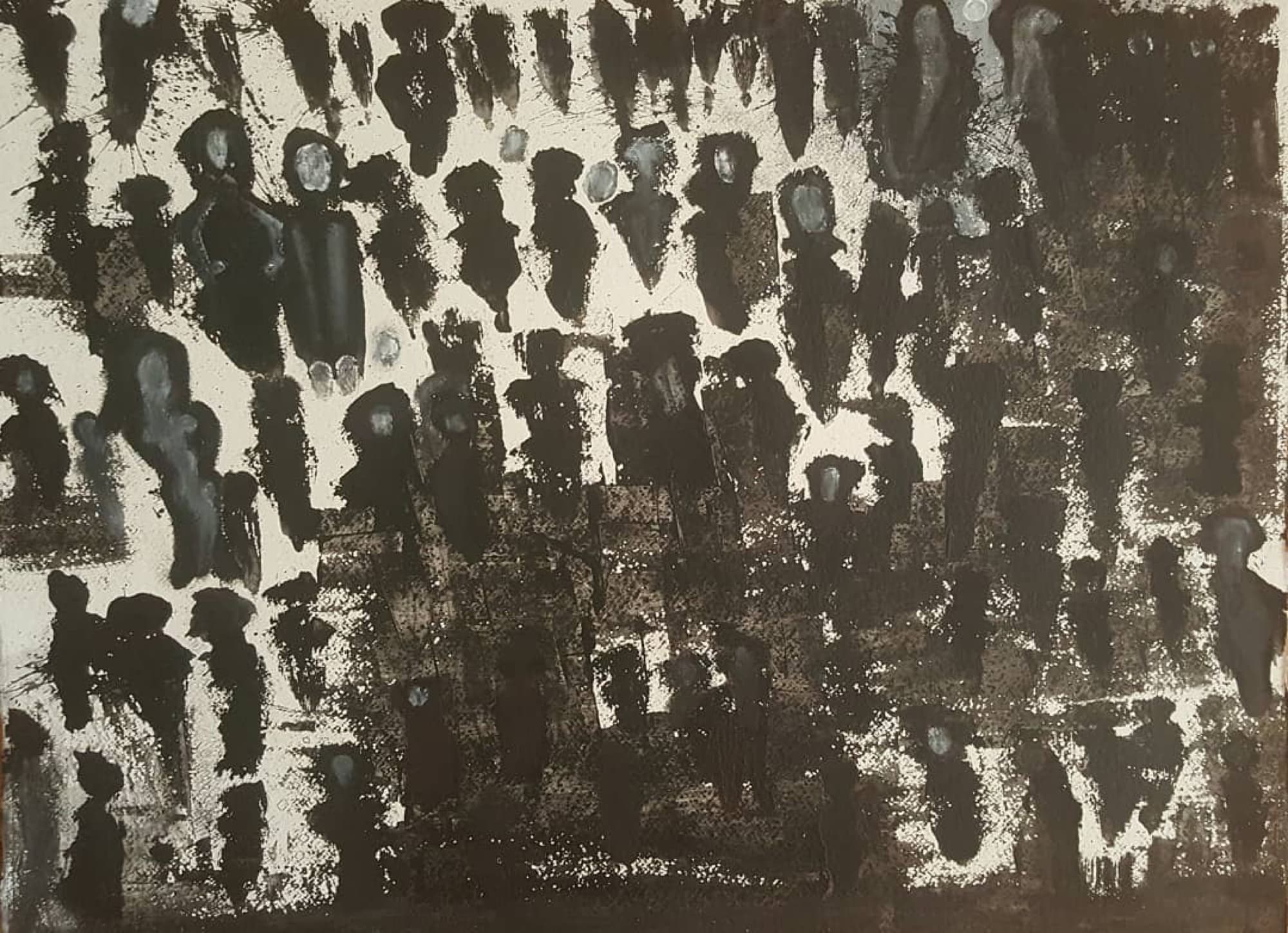
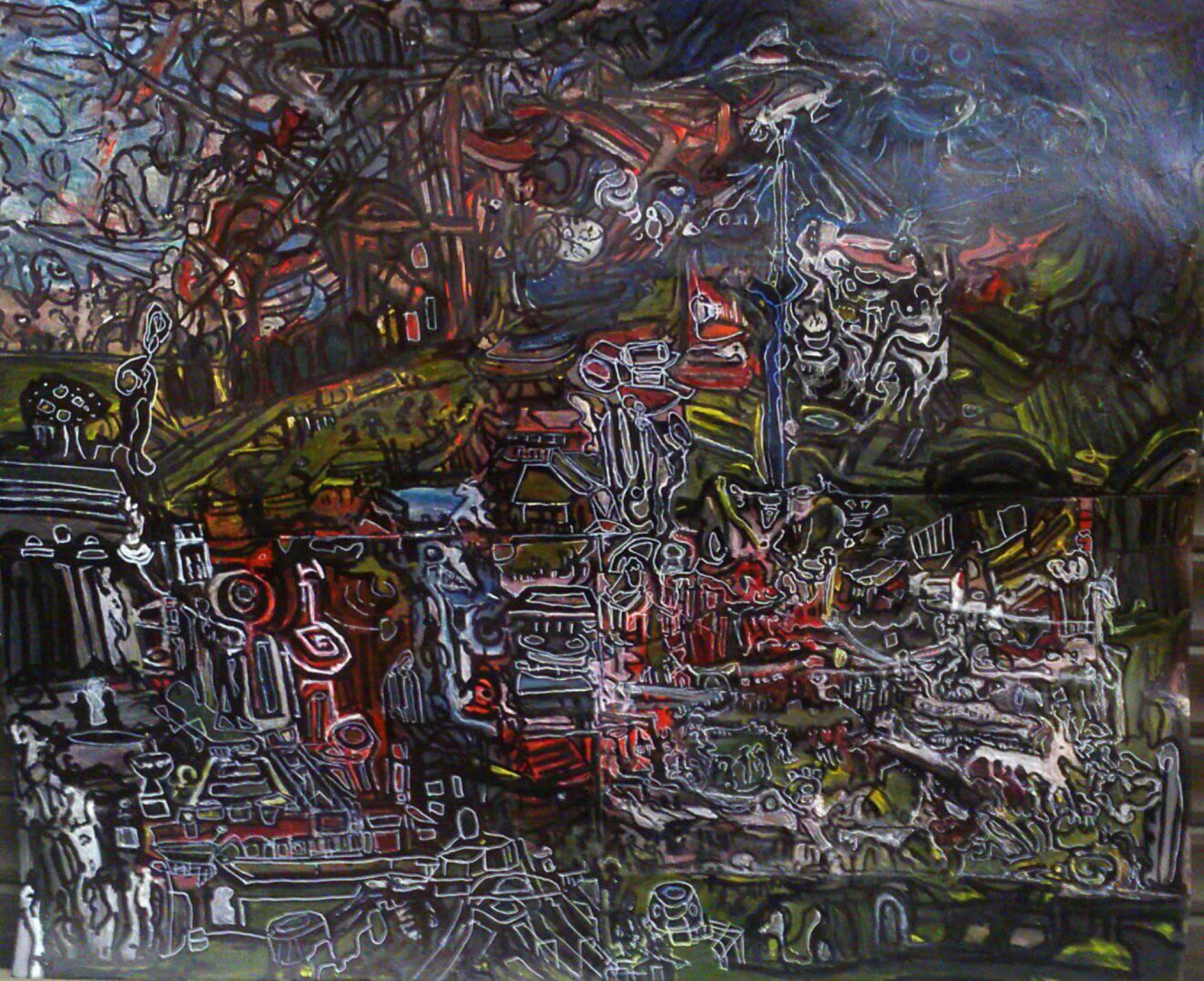
Whoever creates by exploring their own inner time, without losing feeling for the social and historical time through which they are passing, may come to find themselves, more or less consciously, lost in a labyrinth of ambiguous figures and forms: signs left indelibly behind after various erasures and rewritings, unplaceable in any defined time; tracings arrived from a chaotic mass that points back to remote eras, to primordial inner events, and equally to future returns toward conditions akin to the ancestral ones; poised between figuration and schematic synthesis, scenarios, imaginary landscapes full of elementary, atemporal architectural elements, skeletons from a lost psychic past (or future), forebodings, abandoned attempts at edification, fragments of grandiose or squalid constructions, of their own certain future destructions; transfigurations of memories, events, accidents, personal experiences, and together with them references to the collective imaginary of the time at hand, introduced synchronically, autonomously, and unconsciously, in the first and direct creative approach.
The creative act becomes letting all this flow and recording it, deciding nothing beyond what is asked by the image itself, in its taking form, by the imaginary that surfaces within it autonomously, starting from a first originary ideating image that gathers tensions, sensations, strongly attractive suggestions, pathos.
The symbolic can only point back, in this age more than ever, to an inner part whose absence, or whose total foundering upon a boundless horizon, is felt; lost, removed, darkened, it is evoked and summoned unconsciously, in the underground current, never finding the matching pieces within the invisible, among the many scattered fragments.I am for an art that is born of blood, of fireand that originates as a visceral necessity, not as a cold and falsely philosophical operation.
Authentic creativity, the visionary and symbolic urgency in art, must again be brought to the foreground; without the pretension of being 'new' and 'original', one must let the progressivist and futurist myths fall away, leave the illusions to those who (still) wish to be deluded; let the illusion of the value of the new at all costs fall away, not fear being taken for anachronistic and reactionary, for reaction is more than ever necessary today at the artistic level; not fear the descents into the psychic underworld, rediscover the undying value of the imagination, of the archetypal imaginary, and the efficacy of the symbolic expressiveness of the traditional artistic means, as well as of new means usable to give form to the images.
The needs and the modes of expressionism have never died and will have much more to give in the future, transforming themselves with new techniques and hybridized styles; syncretisms may bring fresh lifeblood to Art.
Emanuele Longo